
TREGZI has a demonstrated safety profile

Adverse reactions occurring in ≥10% of patients treated with TREGZI or unmanipulated allograft control arm in Precision-T Study1

TREGZI + Tac
(n=88)
Conventional
alloHSCT + Tac/MTX
(n=94)
Adverse Reactions All Grades
%
Grade 3
or Higher
%
All Grades
%
Grade 3
or Higher
%
Infections and infestationsa
Viral infections 51 14 47 19
Infections–pathogen unspecified 45 18 56 30
Bacterial infections 40 18 38 16
Fungal infections 20 3 18 0
Gastrointestinal disorders
Diarrhea* 69 1 79 6
Abdominal pain* 45 0 54 1
Vomiting 44 1 35 0
Nausea* 41 1 44 2
Immune system disorders
aGVHDb 38 6 46 15
General disorders and administration site conditions
Mucositis* 85 28 88 37
Edema* 30 0 38 3
Respiratory, thoracic, and mediastinal disorders
Pneumonia 5 5 17 15
Skin and subcutaneous tissue disorders
Rash* 65 0 55 0
Vascular disorders
Hemorrhage* 39 6 33 1
TREGZI had lower rates in the majority of Grade ≥3 adverse reactions1

Incidence of serious TEAEs, Grade ≥2 aGVHD, and Grade 3 infections2

Outcome TREGZI + Tac
(n=88)
%
Conventional
alloHSCT +
Tac/MTX
(n=94)
%
Grade 2-4 aGVHD at 6 months 20.1 27.4
Grade 3-4 aGVHD at 6 months 6.2 16.5
Serious TEAEs 38.6 56.4
Estimated cumulative incidence at 1 year
All-grade cGVHD 21.9 67.5
Moderate-to-severe cGVHD 12.6 44.1
Infections Grade 2 or 3 46.9 44.1
Infections Grade 3 8.4 16.1

Systemic treatment for cGVHD (ITT)3

All-grade cGVHD treatment TREGZI + Tac
(n=93)
%
Conventional alloHSCT
+ Tac/MTX
(n=94)
%
Systemic corticosteroids 7.5 33.0
Ruxolitinib +/- belumosudil 3.2 28.7

Rehospitalization and ICU admission rates3-5

Outcome TREGZI + Tac
(n=88)
Conventional
alloHSCT + Tac/
MTX
(n=94)
Participants admitted to ICU 1.1% 4.3%
Average hospitalization days per patient 30.6 40.8
Participants rehospitalized for an AE 27.3% 45.7%
Average duration of rehospitalization (days) 11.6 13.0
Average cumulative duration of rehospitalization (days) 16.1 25.0
TREGZI has the potential to reduce costs associated with immunosuppression due to lower GVHD and infection

Grade 3 or 4 laboratory abnormalities occuring in ≥10% of patients in Precision-T Study1


Laboratory Abnormalityc,d TREGZI + Tac
Grade 3 or Higher
%
Conventional
alloHSCT + Tac/MTX
Grade 3 or Higher
%
Lymphocyte count decreased 98 94
Platelet count decreased 93 96
Leukocyte count decreased 89 89
Neutrophil count decreased 77 83
Hemoglobin decreased 71 81
Alanine aminotransferase increased 12 7

Fewer patients in the TREGZI + Tac arm died due to GVHD or infection vs conventional alloHSCT + Tac/MTX, and none died due to organ failure2
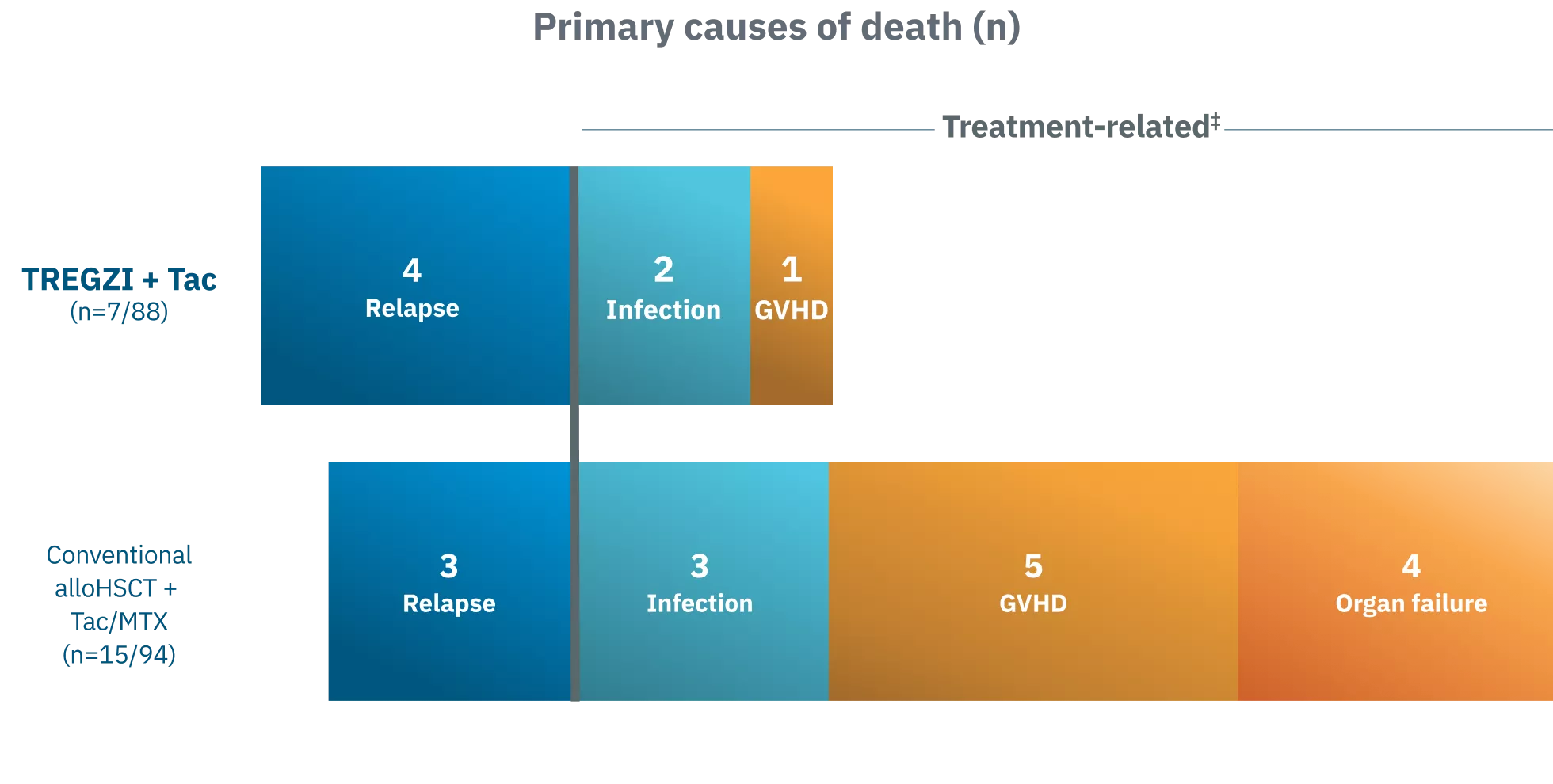
Bar chart showing the primary causes of death in Precision-T. Of the 7 deaths in the TREGZI + Tac arm, 4 were due to relapse, 2 were due to infection, and 1 was due to GVHD. Of the 15 deaths in the conventional alloHSCT + Tac/MTX arm, 3 were due to relapse, 3 were due to infection, 5 were due to GVHD, and 4 were due to organ failure.

TREGZI reduced GVHD and infections common with conventional alloHSCT1,2
*Includes multiple related terms.
The infection percentages from the study publication were scored using the BMT CTN Manual of Procedures, which is specifically designed for use in BMT CTN trials.2
Includes all patients who had an NRM event at data cutoff including those who had an NRM event more than 1 year after transplant.
aInfections and infestations were calculated for the first 2 years after transplantation.
bAcute GVHD graded by MAGIC standardization criteria (Harris 2016) as determined by an independent review committee; calculated for the first year after transplantation.
cIncludes lab abnormalities for the first 100 days.
dBaseline lab values were assessed prior to conditioning regimen. Denominators ranged from 79 to 87 for TREGZI arm and 90 to 93 for Control arm for lab tests, based on the number of patients with a baseline value and at least one post treatment value for each lab test.

AE, adverse event; aGVHD, acute graft-versus-host disease; alloHSCT, allogeneic hematopoietic stem cell transplant; BMT CTN, Blood and Marrow Transplant Clinical Trials Network; cGVHD, chronic graft-versus-host disease; GVHD, graft-versus-host disease; ICU, intensive care unit; MAGIC, Mount Sinai Acute GVHD International Consortium; MTX, methotrexate; Tac, tacrolimus; TEAE, treatment-emergent adverse event.

IMPORTANT SAFETY INFORMATION AND INDICATIONS AND USAGE

ISI tray

ISI tray

INDICATIONS AND USAGE

TREGZI is indicated for use in matched donor hematopoietic stem cell transplantation with myeloablative preparative regimen, for hematopoietic and immunologic reconstitution and to improve chronic graft-versus-host disease-free survival, in the treatment of adults with hematological malignancies.

IMPORTANT SAFETY INFORMATION

WARNINGS AND PRECAUTIONS

Graft Failure: Graft failure has occurred after TREGZI administration. Screen TREGZI recipients for antidonor antibodies that may prevent engraftment. Monitor patients closely for laboratory evidence of hematopoietic recovery.

Graft-Versus-Host Disease: Acute and chronic Graft-Versus-Host disease (GVHD), including life-threatening and fatal cases, occurred following treatment with TREGZI. Acute GVHD manifests as maculopapular rash, gastrointestinal symptoms, and elevated bilirubin. Chronic GVHD may include skin rash, mouth sores, dry eyes, liver inflammation, and development of scar tissue in the skin and joints and damage to the lungs. Treat patients with a single agent calcineurin inhibitor as prophylaxis to decrease the risk of GVHD. Monitor for signs and symptoms of GVHD, and treat if GVHD develops.

Infusion Reactions: Infusion reactions (IRs) may occur during or following treatment with TREGZI. Serious hypersensitivity reactions including anaphylaxis may occur to DMSO, human serum albumin (HSA), Dextran or murine protein present in TREGZI. IRs may begin within minutes of the start of TREGZI infusion, although symptoms may continue to intensify and not peak for several hours after the completion of the infusion. Monitor patients for signs and symptoms of IRs during and after TREGZI administration. When a reaction occurs, pause the infusion and institute supportive care as needed. Premedicate patients with antipyretics and histamine antagonists prior to infusion to reduce the incidence and intensity of infusion reactions.

Secondary Malignancies and Malignancies of Donor Origin: Secondary malignancies and malignancies of donor origin may occur following treatment with TREGZI. Development of secondary malignancies, including posttransplantation lymphoproliferative disorder (PTLD) may occur many years after transplantation. PTLD manifests as a lymphoma-like disease favoring non-nodal sites. PTLD is usually fatal if not treated. Serial monitoring of blood for EBV DNA may be warranted in patients with persistent cytopenias. No patient treated with TREGZI has developed PTLD. Monitor for malignancies of donor origin and secondary malignancies. Contact Orca Bio at 1-877-290-6722 if any patient is diagnosed with a secondary malignancy or a malignancy of donor origin.

Transmission of Infectious Agents: Transmission of serious infectious or communicable disease or agents may occur with TREGZI treatment as it is derived from human donor blood and manufactured using animal-derived reagents. Risks of transmission of infectious agents may occur despite screening or testing of donors. Risks of transmission of serious infections include, but are not limited to, human immunodeficiency virus, human T cell lymphotropic virus (HTLV)-1 and -2, hepatitis B virus (HBV), hepatitis C virus (HCV), Treponema pallidum, Trypanosoma cruzi, West Nile virus (WNV), cytomegalovirus, transmissible spongiform encephalopathy agents and vaccinia. Monitor patients for signs and symptoms of infections, perform tests for infectious agents and treat as clinically indicated.

ADVERSE REACTIONS

The most common adverse reactions (incidence ≥ 20%) were mucositis, diarrhea, rash, viral infections, infections – pathogen unspecified, abdominal pain, vomiting, nausea, bacterial infections, hemorrhage, aGVHD, edema, and fungal infections.

The most common Grade 3-4 laboratory abnormalities (≥ 20%) are lymphocyte count decreased, platelet count decreased, leukocyte count decreased, neutrophil count decreased and hemoglobin decreased.

INDICATIONS AND USAGE

TREGZI is indicated for use in matched donor hematopoietic stem cell transplantation with myeloablative preparative regimen, for hematopoietic and immunologic reconstitution and to improve chronic graft-versus-host disease-free survival, in the treatment of adults with hematological malignancies.

Please see accompanying full Prescribing Information.

References:

  1. TREGZITM (allogeneic regulatory T cell immunotherapy with HSPC and T cells-vldq). Prescribing information. Orca Biosystems, Inc; 2026.
  2. Meyer E, Salhotra A, Gandhi A, et al. Orca-T versus allogeneic hematopoietic stem cell transplantation (Precision-T): a multicenter, randomized phase 3 trial. Blood. 2026;147(11):1168-1177. doi:10.1182/blood.2025031313
  3. Meyer E, Salhotra A, Gandhi A, et al. Orca-T versus allogeneic hematopoietic stem cell transplantation (Precision-T): a multicenter, randomized phase 3 trial. Supplemental appendix. Blood. 2026;147:1168-1177. doi:10.1182/blood.2025031313
  4. Data on file. Orca Biosystems, Inc; 2026.
  5. Gandhi A, Purdum A, Pavlova A, et al. Orca-T demonstrates favorable quality of life and healthcare resource use compared to standard alloHSCT plus Tac/MTX for GVHD prevention in a randomized phase 3 clinical trial (Precision-T). Poster presented at: Tandem Meetings Transplantation & Cellular Therapy Meetings of ASTCT® CIBMTR®; February 2026; Salt Lake City, UT.